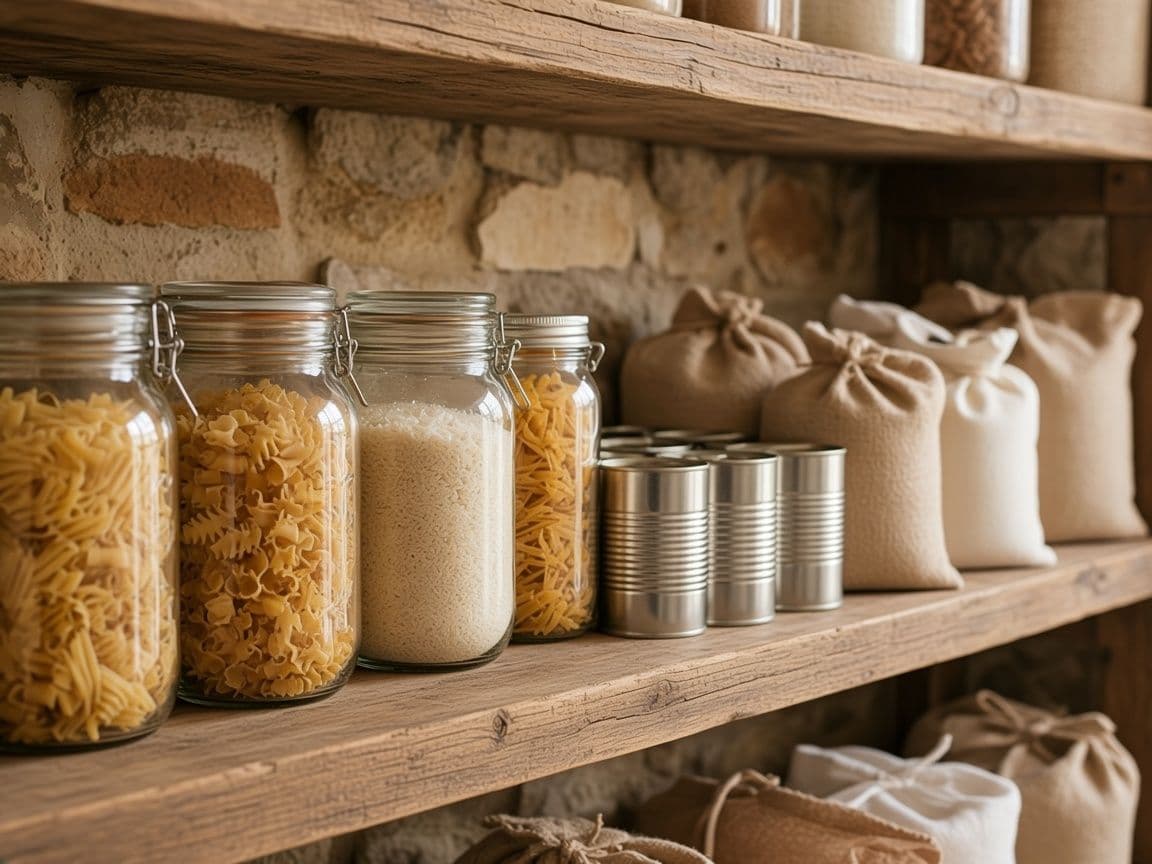
Official advice in many European countries starts with a few days of non-perishable food and drinking water at home. This guide is for the harder case: shops are closed or unreachable, deliveries have stopped, or you cannot safely leave—and you must make what is already in the house last. The aim is not to starve yourself. It is to stop chaotic eating on day one so everyone still has something on day seven, fourteen, or beyond.
Rationing is a planning skill. Used calmly, it stretches supplies, protects morale, and reduces arguments. Used badly—especially for children, pregnant people, or anyone who is ill—it causes harm. Read the whole plan before you cut portions.
1. Take stock before you eat anything
Do not wait until the cupboard looks empty. Empty every relevant shelf, fridge, freezer, and grab-bag onto a table (or write a list room by room) and sort into clear groups:
- Water and drinks: sealed bottles, filled containers, UHT milk, squash that needs water, tea and coffee (note: these need water and sometimes heat).
- Eat first: fresh fruit and veg, opened dairy, cooked leftovers, soft bread—anything that spoils in days.
- Fridge and freezer: use while power holds; plan thaw order if outages are likely.
- Shelf-stable staples: tins, jars, dried pasta and rice, oats, crackers, peanut butter, long-life milk, emergency ration biscuits.
- Cooking needs: gas canisters, solid fuel, matches, camping stove, and how much water each meal needs to cook.
- Special lines: baby formula, medical nutrition, pet food—these are not “extra” adult calories; keep them ring-fenced.
Write totals: litres of drinking water, number of main-meal portions, snack items, and fuel. A written inventory stops guesswork and “I’ll just open one more tin” decisions.
2. Water comes before clever meal plans
You can go far longer without food than without water. Set a hard daily drinking-water ration per person first (many preparedness guides use roughly 2–3 litres of drinking water per person per day as a planning figure, plus extra for cooking and hygiene if you have it). Separate:
- Drinking water (sealed, boiled, or properly treated).
- Cooking water (can be the same grade as drinking if meals need it).
- Hygiene water (can be lower grade if necessary—hand washing, flushing—never mix containers).
If stocks are short, favour no-cook or low-water meals (tinned food eaten cold, crackers, nut butters, ration biscuits) over pasta and rice that burn both fuel and water. Keep purification tablets or a filter as backup for collected water—see our collecting water guide—and never drink chemically contaminated or foul-smelling water.
3. Decide who you are feeding—and for how long
Count every mouth: adults, children, guests, and pets. Needs differ by age, size, pregnancy, illness, and how active people will be. In a stay-at-home disruption, activity (and calorie need) often drops. In a cold house, physical work, or evacuation on foot, it rises.
Use labels and a rough calorie count for packaged goods. For unlabelled foods, estimate once and write it down. Then pick a planning horizon you can defend: for example “stretch to 14 days” or “stretch until the next known delivery window.” Divide usable main-meal portions by days and by people. That number is your daily ration ceiling—not a suggestion.
Thrive vs survive: recommended daily calories assume health and normal life. Healthy adults at rest can sometimes manage on less for a short period. Do not apply harsh adult cuts to children, pregnant or breastfeeding people, or anyone frail or unwell. Their portions stay closer to normal needs; adults absorb the shortfall first.
4. Eat in the right order
- Day 0–2: perishables and opened packs. Cook or combine what will spoil. Do not open a new tin while lettuce wilts unused.
- While power lasts: freezer food in planned batches. Keep the freezer closed. A full freezer stays cold longer than a half-empty one. Once thawed, cook and eat—do not refreeze thawed meat without cooking first.
- Then: fridge leftovers and short-life dairy.
- Last: sealed tins, dried goods, and dedicated emergency rations. Those are your deep reserve.
5. Set a simple daily structure
Guessing meal-by-meal burns stock. Use a fixed pattern so everyone knows what is coming:
- Breakfast — one measured portion (oats, cereal, crackers + spread, or a planned tin).
- Midday meal — one main portion.
- Evening meal — one main portion (often the largest share of the day’s calories).
- Snacks — a small, pre-counted bag for the day (not an open family biscuit tin).
- Optional treat — one square of chocolate, a sweet tea, or similar. Morale food is not waste if it is budgeted.
On hard days, two meals plus water may be enough for healthy adults. Keep the clock: meals become breaks in monotony and something to look forward to, instead of continuous grazing that empties the cupboard by Wednesday.
6. Portion by day—accountability beats willpower
The most reliable method, borrowed from multi-day hiking, is to pack each day’s food into its own bag or box and label it Day 1, Day 2, Day 3. Eat only from today’s bag. Put unfinished snacks into tomorrow’s bag at night—do not “borrow” from Day 5 because you are bored.
If bagging everything is impractical, at least portion snacks by day. Chocolate, nuts, biscuits, and jerky vanish first when left in one open bowl. Pre-measure dry goods (pasta, rice, oats) at home into single-meal bags with the water amount written on the bag so you do not cook a family-size pan for two people.
In a household, write the rule once and stick it where everyone sees it: who decides portions, what time meals are, and that the emergency bag is off-limits. Soft rules (“eat when hungry but not too much”) fail under stress. Clear numbers work.
7. Keep meals as balanced as you can
Pasta every meal is filling and dull—and thin on protein and micronutrients. Rotate across what you have: carbohydrates (rice, pasta, oats, crackers), protein (tinned fish, beans, meat, peanut butter, milk powder), fats (oils, nut butters, cheese if still good), and any fruit, veg, or juice still available. Your body stores energy as fat; it does not store every vitamin and mineral well. Even small daily amounts of varied food matter more than one huge carbohydrate binge.
Salt, electrolytes, and hot drinks help if people are sweating, stressed, or living in a cold house—budget them like food, not as free extras.
8. Protect an emergency reserve you do not touch
After you set daily portions, seal one full day of food and water per person (more if you can) and put it somewhere separate. That bag is for true extensions only: delayed help, illness, a neighbour in worse shape, or an unexpected extra night. Rules for the reserve:
- High calorie, ready to eat with little or no cooking (ration biscuits, bars, nut butter, some tins).
- Does not depend on the last of your fuel.
- Comes home unopened if the crisis ends early—that is success, not waste.
9. Leftovers, fuel, and waste
- Finish opened food at the next meal or fold it into tomorrow’s breakfast. Do not throw edible leftovers “to keep the plan tidy.”
- If you always have leftovers, shrink tomorrow’s portions—your first estimate was high.
- Count cooking fuel as part of the ration. One hot meal a day may be enough; use no-cook options for the other.
- Do not feed wildlife or burn food waste indoors. Bag rubbish securely; pests and smells make a bad situation worse.
10. End-of-day review (five minutes)
Each evening: check tomorrow’s bag, move unfinished snacks into it, confirm drinking-water bottles for the morning, and note anything that spoiled or was opened early. Adjust the remaining days’ portions once—then stick to the new numbers. Constant renegotiation is how groups run out early.
Why rationing works when it feels hard
- Morale: scheduled meals give the day a shape. Something to look forward to beats regretting an empty cupboard.
- Efficiency: mild, planned calorie cuts for healthy adults use body reserves; zero food left forces desperation.
- Accountability: a written daily limit beats “just one more” when you are bored, scared, or stuck indoors.
What this is not
This is not a reason to strip supermarket shelves while shops are still open. Steady stockpiling before a crisis—buying what you already eat, rotating it—is the calm version of preparedness (see panic buying vs stockpiling). Rationing starts when the supply you have must last. If you can still shop safely, top up water and familiar staples without clearing aisles, then go back to a normal rotation.
Related guides on this site
- Non-perishable food for 3 days (UK) — what to keep on hand before a crisis.
- Panic buying vs stockpiling — how to build stores without harming others.
- Collecting water — filters, tablets, and what not to drink.
Keep country supply checklists and Be Ready pages for your location alongside this plan. Local official guidance always wins on volumes and boil-water notices.